How Patent Evidence Can Strengthen an EB-1A Scientist Petition
A patent can strengthen an EB-1A petition only when it shows more than inventorship. USCIS is not deciding whether the invention was patentable. USCIS is deciding whether the full record shows sustained national or international acclaim, recognized achievements, and a level of expertise placing the applicant among the small percentage who have risen to the very top of the field. For scientists, researchers, engineers, biotech specialists, medical innovators, software architects and technology founders, the strongest patent argument is built around documented impact: what problem the invention solved, what the applicant personally contributed, who independently used or cited the work, and why that use mattered beyond the applicant’s employer, lab or immediate team.
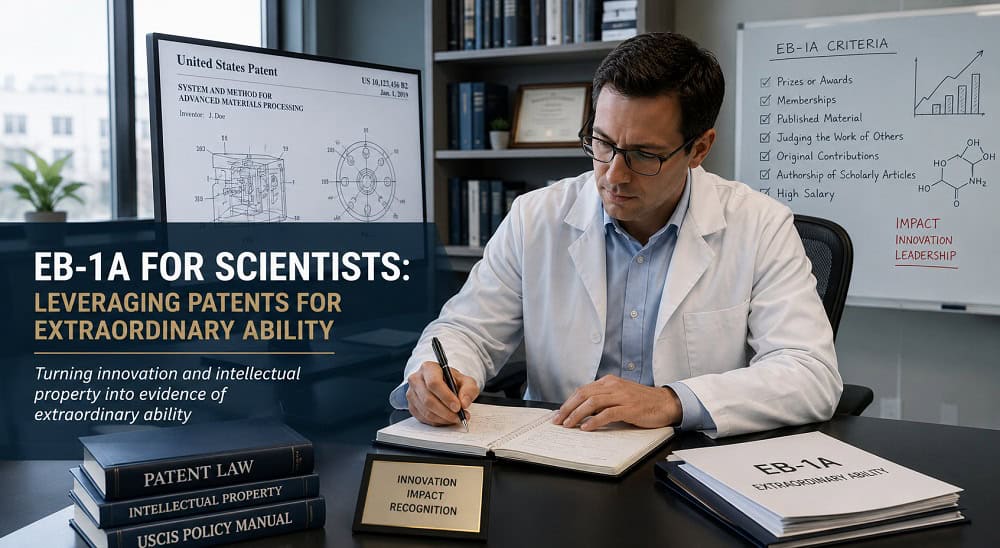
Direct answer: patents can support EB-1A when they show original work and documented impact. A patent certificate alone usually proves that the applicant was named as an inventor, not that the applicant has extraordinary ability. The persuasive record connects the applicant’s personal contribution to independent citations, licensing, adoption, commercial use, institutional reliance, expert recognition or a measurable change in the field.
Are Patents Enough for EB-1A?
Patents alone are usually not enough for EB-1A. A granted patent may show that an invention met patent-law requirements, but EB-1A requires a different type of proof. The petition must show that the applicant made a recognized contribution that matters in the field and that the contribution is supported by reliable, preferably independent, evidence.
This is especially important for corporate and university patents. Many scientific patents are assigned to an employer, university or research institution. That does not make the patent useless for EB-1A, but it creates a proof issue: the petition must separate the applicant’s role from the institution’s ownership and from the work of co-inventors. If several inventors are listed, the record should explain which technical insight, experimental design, algorithm, compound, device architecture, method or implementation step belongs to the applicant.
What a strong patent package looks like
A strong petition does not submit the patent as a standalone exhibit and expect USCIS to infer its importance. The patent should be supported by a plain-English explanation of the invention, evidence of the applicant’s personal role, independent patent citation reports, licensing or deployment records, related publications, product or clinical-use documentation, and expert letters explaining why the contribution mattered to a method, product, process, platform or line of research.
When Patents Help an EB-1A Scientist Petition
Patents help when they do more than prove that the applicant was named as an inventor. The petition must connect the invention to recognized professional impact. A USCIS officer should be able to trace the chain from technical contribution to field-level significance without guessing or relying on broad claims.
Strong patent evidence answers four questions
- What problem existed before the invention? The petition should explain the scientific, technical or commercial gap in plain English before adding field-specific detail.
- What did the applicant personally contribute? This is critical when patents list several inventors or when the patent is assigned to an employer, university or research institution.
- Who independently used or cited the work? Independent citations, licensing, standards relevance, product use, clinical adoption or third-party implementation matter more than internal praise.
- Why did that use matter? The record should explain whether the invention improved accuracy, safety, efficiency, scalability, reproducibility, durability, cost, speed or adoption of a method.
A patent certificate alone often proves only that the applicant was named as an inventor. It usually does not prove that the invention was a major contribution. Weak patent-based petitions often fail because they prove originality or participation, but not recognized influence beyond the applicant’s own workplace or research group.
What EB-1A Requires Beyond Inventorship
EB-1A is the employment-based first preference classification for individuals with extraordinary ability in the sciences, arts, education, business or athletics. Under 8 CFR 204.5, extraordinary ability means a level of expertise indicating that the person is one of the small percentage who have risen to the very top of the field. The petition must also show sustained national or international acclaim and recognition of achievements.
EB-1A does not require a U.S. job offer or labor certification, but the applicant must show an intention to continue work in the same area of expertise in the United States. Most applicants do not rely on a one-time major internationally recognized award. Instead, they must satisfy at least three regulatory criteria and then pass the final merits determination, where USCIS evaluates the total record to decide whether the applicant has actually demonstrated extraordinary ability.
EB-1A criteria often relevant to scientists with patents
- Original contributions of major significance: the most direct criterion for patent evidence, but only when the record shows significance beyond legal inventorship.
- Scholarly authorship: peer-reviewed publications related to the invention can show that the work entered the scientific record.
- Judging the work of others: peer review, grant review, conference review, editorial work or technical evaluation may show recognition by the field.
- Leading or critical role: evidence that the applicant’s work was central to a distinguished company, lab, research group, institution or product line.
- Published material about the applicant: independent coverage of the scientist and the work, not merely employer marketing or a press release.
- High salary or remuneration: compensation evidence compared with others in the same role, field and geography.
- Awards: nationally or internationally recognized prizes, including documented team awards where the applicant’s role is clear.
Patents usually work as one part of a larger evidence record, not as a standalone shortcut to EB-1A. A patent may support original contribution; related papers may support scholarly authorship; independent citations may support influence; licensing records may support practical use; and expert letters may explain why the invention mattered. The petition should connect these pieces into one clear evidentiary story.
How Patents Can Prove Original Contributions of Major Significance
USCIS may recognize that a granted patent reflects originality, but originality is only part of the argument. The harder part is major significance. Many scientists are named inventors. Fewer can show that their invention changed practice, influenced later research, supported a commercial product, improved a clinical or industrial workflow, entered a technical standard or was used by independent organizations.
For a biotech researcher, strong evidence may include validation data, diagnostic accuracy, clinical workflow adoption or licensing to a medical technology company. For a software architect, it may include enterprise deployment, independent implementation, technical architecture adopted by unrelated organizations or measurable performance improvement. For a materials scientist or engineer, it may include durability gains, failure-rate reduction, manufacturing scalability or use in high-stress industrial systems.
| Patent Evidence | What It Can Prove | What Makes It Strong |
|---|---|---|
| Granted patent | The invention was recognized as patentable. | A clear explanation of the applicant’s specific inventive role, especially when there are multiple inventors. |
| Independent patent citations | Later innovators referenced or built around the patented work. | Citations from unrelated companies, universities, laboratories or institutions with recognized standing. |
| Licensing or commercialization | The invention moved from concept into practical use. | Licensing agreements, product integration, deployment evidence, revenue records or customer adoption. |
| Institutional or product adoption | The invention solved a real technical problem. | Use in clinical workflows, industrial systems, research platforms, diagnostics, software infrastructure or technical standards. |
| Independent expert letters | Qualified people in the field recognize the invention’s importance. | Specific, document-based letters from experts who are not close collaborators and can explain field-level impact. |
Patent Impact Ladder for EB-1A Evidence
USCIS does not assign points to patents. This ladder is a practical evidence model: the same patent can be weak or strong depending on whether the surrounding record proves independent use, practical adoption and recognized influence.
Stronger and Weaker Patent Arguments
The number of patents is less important than what happened because of them. A scientist with one invention that changed a research method, supported a commercial product, improved a diagnostic workflow or was repeatedly cited by independent innovators may have stronger patent evidence than a scientist with ten patents that remained inside an employer’s internal portfolio.
Strong example
A materials scientist is listed as a co-inventor on a granted patent covering a coating method that improves durability in a high-stress industrial environment. The petition does not rely on the patent certificate alone. It shows that the applicant designed the key experimental approach, published related peer-reviewed research, received independent patent citations from unrelated manufacturers and documented licensing or adoption by a third-party company.
Expert letters explain how the method improved performance, reduced failure rates or made production more scalable. This pattern is stronger because the record connects inventorship to documented use outside the applicant’s immediate institution.
Weak example
A researcher submits five patents assigned to an employer. The petition includes patent certificates and a short internal letter praising the researcher as “innovative,” but it does not explain the applicant’s specific role, does not show independent citations, does not include licensing or product adoption records and does not connect the patents to publications, grants, standards or third-party implementation. This evidence may prove participation in inventive work, but it does not reliably prove original contributions of major significance.
If the patent lists several inventors
Scientific patents often list several inventors. That is normal, but it creates a proof issue. USCIS still needs to understand what the applicant personally contributed. The petition should identify the technical insight, experimental design, algorithm, compound, device architecture, method or implementation step attributable to the applicant and explain why that contribution was central. A broad statement that the applicant was “part of the team” is usually too weak.
What USCIS May Give Limited Weight
Patent evidence becomes weaker when it is isolated, internally generated or unsupported by independent records. The petition package must bridge the gap between legal inventorship and recognized significance in the field.
Evidence that usually needs stronger support
- Patent pending applications with no adoption, citation, licensing or independent recognition.
- Patent certificates alone without an explanation of why the invention mattered beyond patentability.
- Employer-only letters that praise the applicant but do not provide external validation.
- Marketing materials that describe a product but do not connect the applicant to the core technical contribution.
- Related-party citations from the applicant’s own company, collaborators or controlled entities without broader field reliance.
- Generic expert letters that use strong adjectives but do not cite facts, metrics, records or independent examples.
- Large patent counts with no evidence that others used, cited, licensed, implemented or built upon the inventions.
These documents can still help establish context. Internal records may clarify the applicant’s role. Employer documents may explain product development. Pending patents may show the direction of current work. But the central EB-1A argument becomes much stronger when internal evidence is supported by objective, independent proof.
Evidence Map for a Patent-Based EB-1A Petition
A strong patent-based EB-1A petition is organized around impact, not paperwork volume. The most effective structure starts with the applicant’s strongest invention and builds outward: technical problem, applicant’s contribution, external recognition, practical adoption and future work in the United States.
| Evidence Category | Purpose in the Case | Best Supporting Documents |
|---|---|---|
| Inventorship and role | Shows what the applicant personally contributed. | Patent documents, invention disclosures, technical declarations, lab records, internal invention summaries. |
| External use | Shows that others used or built on the work. | Patent citation reports, independent publications, product references, standards documents, third-party implementation records. |
| Commercial or institutional use | Shows that the invention solved a practical problem. | Licensing agreements, revenue evidence, deployment records, customer documentation, clinical or industrial use records. |
| Field recognition | Explains why the contribution was significant. | Independent expert letters, awards, invited talks, media coverage, grant records, citations by recognized organizations. |
| Future U.S. work | Shows the applicant will continue work in the area of expertise. | Research plans, contracts, letters of intent, startup documentation, prospective collaborations, funding or commercialization plans. |
How to write the patent section clearly
- Start with the scientific or technical problem, not the patent number.
- Explain the invention in plain English before adding technical detail.
- Separate the applicant’s role from the role of co-inventors, employers and institutions.
- Use independent proof whenever possible: citations, adoption, licensing, product records, expert analysis or external implementation.
- Connect the patent to other EB-1A evidence, including publications, peer review, grants, awards, critical role or remuneration.
- Show how the applicant will continue the same area of work in the United States.
Visa Bulletin and Premium Processing Context
EB-1A eligibility and green card timing are related but separate. Approval of Form I-140 does not always mean adjustment of status or immigrant visa issuance is immediately available. Timing depends on chargeability area, priority date and the monthly Visa Bulletin. Chargeability usually refers to the country used for visa-number allocation, commonly the country of birth unless a specific exception applies.
For June 2026, USCIS instructs employment-based adjustment applicants to use the Final Action Dates chart. The June 2026 Visa Bulletin lists EB-1 final action dates as current for all chargeability areas except China-mainland born and India. China-mainland born is listed as April 1, 2023. India is listed as December 15, 2022. Mexico, the Philippines and all other chargeability areas except those listed are current.
| Chargeability Area | June 2026 EB-1 Final Action Date | Practical Meaning |
|---|---|---|
| All chargeability areas except those listed | Current | Visa numbers are authorized for qualified applicants. |
| China-mainland born | April 1, 2023 | The priority date must be earlier than the listed final action date. |
| India | December 15, 2022 | The priority date must be earlier than the listed final action date. |
| Mexico and Philippines | Current | Visa numbers are authorized for qualified EB-1 applicants. |
Premium processing can be useful when a scientist wants faster USCIS action on the I-140 petition. It does not improve the evidence, cure weak documentation or guarantee approval. Effective March 1, 2026, the premium processing fee for eligible Form I-140 requests is $2,965. The fee is separate from regular filing fees and is submitted with Form I-907.
FAQ: Patents and EB-1A for Scientists
Do patents automatically qualify a scientist for EB-1A?
No. Patents can support an EB-1A petition, especially under the criterion for original contributions of major significance, but they do not automatically prove extraordinary ability. USCIS must see recognized achievements, sustained acclaim and evidence that the applicant is among the small percentage at the top of the field.
Are pending patents useful in an EB-1A petition?
Pending patents may provide context, but they are usually weaker than granted patents and much weaker than patents supported by independent impact evidence. A pending application becomes more useful when it is tied to publications, implementation, licensing discussions, external validation or a clearly documented technical contribution.
How many patents are enough for EB-1A?
There is no required number. One highly influential patent can be stronger than several unused patents. USCIS focuses on the quality, recognition and significance of the contribution, not a simple patent count.
Can a patent owned by an employer still help the scientist?
Yes, if the record proves the applicant’s personal contribution. Many patents are assigned to employers. The issue is not ownership alone; the issue is whether the applicant can show inventorship, technical responsibility and the significance of the invention through reliable evidence.
Are patent citations enough?
Patent citations can help, especially when they come from independent and respected organizations. But citations are stronger when explained in context: who cited the patent, why the citation matters, whether the later work relied on the invention and whether the citation pattern shows broader field influence.
What is the most common weakness in patent-based EB-1A cases?
The most common weakness is treating the patent certificate as proof of major significance. A better case explains the applicant’s role, shows external use or recognition and connects the patented invention to the broader record of publications, citations, judging, leadership, awards or adoption.
What a Strong Patent-Based EB-1A Record Should Show
Patents can be powerful evidence in an EB-1A petition for scientists, but only when they are presented as proof of real impact. The goal is not to show that the applicant appears in a patent database. The goal is to show that the applicant created original work, that the work mattered beyond the applicant’s immediate setting and that the field recognized or relied on the contribution.
A persuasive patent-based EB-1A case explains the invention in practical terms, documents the applicant’s individual role, proves independent impact and connects patent evidence to the regulatory criteria. When patents are supported by publications, citations, licensing, implementation, expert recognition and a credible plan to continue work in the United States, they can help present the scientist not merely as an inventor, but as a leading contributor in the field.
Official Sources Explained
Checked: June 16, 2026.
These sources verify the legal and filing basis for the article: EB-1A eligibility standards, USCIS evidence review, Visa Bulletin timing and premium processing context.
- 8 CFR 204.5 — Employment-Based Immigrant Petitions and EB-1A Criteria Federal regulation defining EB-1 extraordinary ability, including the “small percentage” standard, sustained acclaim requirement and regulatory evidence criteria.
- USCIS Policy Manual, Volume 6, Part F, Chapter 2 — Extraordinary Ability USCIS adjudication guidance explaining how evidence is reviewed, how the two-step analysis works and how final merits determination is applied.
- USCIS EB-1 Extraordinary Ability Guidance Update USCIS policy alert clarifying how certain types of evidence may be evaluated in EB-1 extraordinary ability cases.
- U.S. Department of State — Visa Bulletin for June 2026 Official monthly visa availability bulletin used to verify whether an EB-1 priority date is current or subject to a cutoff date.
- USCIS — Adjustment of Status Filing Charts from the Visa Bulletin USCIS page identifying which Visa Bulletin chart adjustment of status applicants must use for filing.
- USCIS — Premium Processing Fee Update Effective March 1, 2026 USCIS alert explaining updated premium processing fees, including the $2,965 fee for eligible Form I-140 premium processing requests.
- Federal Register — Adjustment to Premium Processing Fees Federal Register publication documenting the premium processing fee adjustment rule and its regulatory background.
Guidance on related U.S. immigration categories
Compare eligibility criteria, filing procedures, documentation requirements, and practical considerations for U.S. immigration categories relevant to this topic.
-
EB-1 talent visa
Review the first-preference employment-based category and its three subcategories.
-
EB-1A visa requirements
For independent extraordinary ability cases built around evidence of sustained acclaim and field impact.
-
EB-1B visa
For internationally recognized professors and researchers with a qualifying employer.
-
Employment-based green card options
Compare EB-1, EB-2, EB-3, NIW, PERM, I-140 and final green card planning in one employment-based framework.
-
O-1 visa
A temporary talent visa that can be relevant when comparing EB-1A and nonimmigrant options.
