PERM in 2026: PWD, Recruitment, ETA-9089, Audit, Supervised Recruitment and I-140 Strategy
PERM labor certification remains a highly regulated stage in many employer-sponsored EB-2 and EB-3 green card cases. It is not a general review of how valuable the foreign worker is to the company. It is a Department of Labor process focused on a specific permanent, full-time job opportunity, the U.S. labor market for that job, the offered wage, the employer’s recruitment, and the consistency of the record before Form I-140 is filed with USCIS.
A reliable PERM case in 2026 should not begin with Form ETA-9089. It should begin with a precise job description, defensible minimum requirements, a realistic worksite analysis, a correct prevailing wage strategy, recruitment that gives U.S. workers a genuine opportunity to apply, and a complete audit file before submission. Remote and hybrid roles, travel, multiple worksites, layoffs, founder-controlled companies and beneficiary influence can be addressed, but they must be analyzed before the case is filed.
Practical sequence: job description → minimum requirements → prevailing wage determination (PWD) → recruitment → cooling period and timing review → ETA-9089 → audit readiness → I-140. Each step should describe the same job opportunity. Inconsistency between the PWD, advertisements, Notice of Filing, ETA-9089 and I-140 evidence is one of the most common sources of PERM and post-PERM risk.
What PERM Does in EB-2 and EB-3 Cases
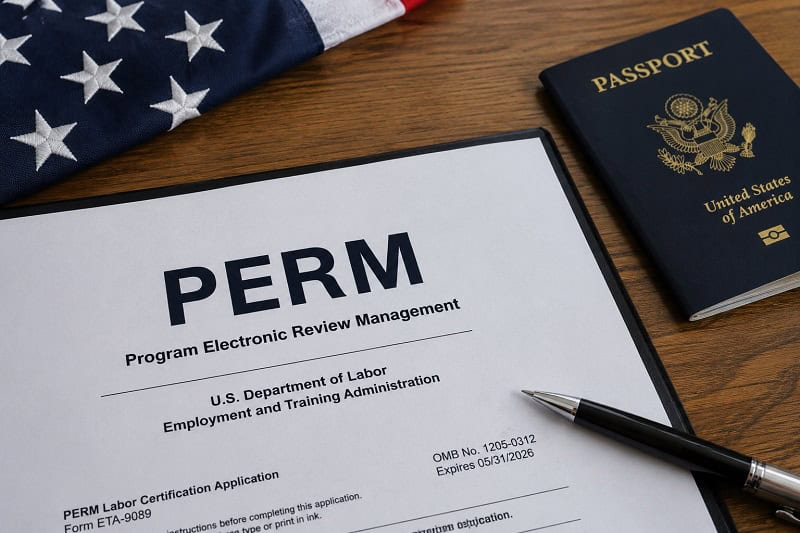
PERM, formally known as permanent labor certification, is administered by the U.S. Department of Labor through the Office of Foreign Labor Certification. In most standard employer-sponsored EB-2 and EB-3 cases, the employer must obtain a certified labor certification before filing Form I-140, Immigrant Petition for Alien Workers, with USCIS. The purpose is to protect the U.S. labor market by confirming that there are not sufficient U.S. workers who are able, willing, qualified and available for the job opportunity in the area of intended employment, and that hiring the foreign worker will not adversely affect the wages and working conditions of similarly employed U.S. workers.
PERM does not ask whether the sponsored employee is talented, loyal or already important to the employer. The legal inquiry is narrower: whether the employer has a genuine permanent job, offered at or above the prevailing wage, open to qualified U.S. workers through a legally sufficient recruitment process. The employer must be able to show that the job was not written or recruited in a way that improperly excluded U.S. applicants.
| Immigration path | PERM usually required? | Who files? | Main legal focus |
|---|---|---|---|
| Standard EB-2 through employer | Yes | Employer | Permanent job offer, PWD, recruitment, ETA-9089 and I-140 eligibility. |
| Standard EB-3 through employer | Yes | Employer | Labor market test, qualifying job requirements and worker eligibility. |
| EB-2 NIW | No | Applicant or representative | National interest waiver, proposed endeavor and applicant qualifications. |
| Schedule A | Not through the standard PERM process | Employer | DOL-designated shortage category and USCIS filing rules. |
PERM should be treated as the foundation of the employment-based green card strategy. USCIS later reviews whether the offered position is the same as the DOL-certified position, whether the beneficiary met the certified requirements by the required date, and whether the employer has the ability to pay the proffered wage. A PERM file with gaps or inconsistencies can therefore create problems even after DOL certification.
The Correct PERM Order: From Job Description to I-140
A defensible PERM strategy starts with the employer’s business need, not with a preferred employee’s resume. The employer should define the actual permanent role it needs to fill: duties, reporting structure, tools, worksite, remote or hybrid policy, travel expectations, client-site work, minimum education, experience and special skills. These details affect occupational classification, wage level, recruitment language, Notice of Filing, applicant review and the final ETA-9089.
The role must describe a genuine full-time permanent position. Duties should be specific enough to classify the job correctly but should not read like a biography of the sponsored worker.
Education, experience, licenses, language skills and technical requirements must be job-related and defensible. Requirements above the normal level for the occupation may require a business necessity explanation.
The employer requests a PWD through DOL. The wage determination anchors the offered wage and must correspond to the same job opportunity that will appear in recruitment and ETA-9089.
The employer conducts the required labor market test, posts the Notice of Filing, reviews U.S. applicants and documents lawful, job-related reasons for rejection.
Recruitment steps must fall within the permitted timing window. Before filing, dates, publication proof, applicant review and Notice of Filing documentation should be checked against the filing deadline.
The PERM application should be filed only after the employer confirms that the PWD, ads, Notice of Filing, recruitment report and job requirements all describe the same position.
The audit file should exist before filing. The employer must retain the PERM application and supporting documentation for five years from the filing date.
After DOL certifies PERM, the employer files Form I-140 with USCIS and proves the requested immigrant category, ability to pay and beneficiary’s qualifications.
PWD and Prevailing Wage Strategy
The Prevailing Wage Determination defines the minimum wage level that must be offered for the PERM position. The request should accurately disclose job duties, requirements, worksite and special conditions. If the employer under-describes the role to obtain a lower wage, the later record may become internally inconsistent.
PWD analysis is especially important for modern roles. Remote jobs require careful identification of the area of intended employment. Hybrid roles need a clear reporting office and worksite structure. Travel and client-site work should be disclosed if they are part of the job. Multiple worksites can affect wage source, recruitment geography and applicant expectations. The goal is not to make the job appear simpler; the goal is to describe the job accurately before recruitment begins.
| PWD issue | Why it matters | What to check before filing |
|---|---|---|
| Incomplete duties | The wage may be issued for a simpler role than the actual job. | Real responsibilities, tools, reporting lines and level of independent judgment. |
| Unclear remote or hybrid work | The area of intended employment may be unclear for wage and recruitment purposes. | Primary office, remote locations, reporting structure and internal remote work policy. |
| Travel omitted | Travel can affect job conditions and must be visible to U.S. applicants. | Frequency, geography, overnight travel, client visits and connection to duties. |
| Excessive requirements | DOL may question whether the job is genuinely open to U.S. workers. | Industry norms, prior hiring history and business necessity. |
Recruitment, Notice of Filing and Timing Rules
PERM recruitment is a regulated labor market test. For professional occupations, the employer must use mandatory recruitment steps and additional recruitment methods. U.S. workers must have a real opportunity to learn about the job, apply and be considered under the stated minimum requirements. The employer may reject applicants only for lawful, job-related reasons.
Timing is critical. Mandatory recruitment steps for professional occupations must generally be completed at least 30 days and no more than 180 days before filing ETA-9089. The Notice of Filing must be posted for at least 10 consecutive business days and must be visible to workers at the place of employment. Additional recruitment steps have their own timing limits, and only one additional step may fall completely within the final 30 days before filing.
Recruitment before the PWD is issued requires caution. The employer must have a valid PWD to file the PERM application. If recruitment is started before the wage determination is known, the employer should not rely on those ads unless the final PWD, job duties, requirements, worksite, wage level and recruitment language remain consistent with the case.
| Recruitment element | Compliance focus | Common problem |
|---|---|---|
| SWA job order | Correct dates, correct worksite and role matching the PERM position. | Job order dates outside the filing window or inconsistent job location. |
| Newspaper or professional journal ads | Accurate job title, employer, location and application method. | Ads describe a role that does not match PWD or ETA-9089. |
| Additional recruitment | Proper methods, documented dates and proof of placement. | Insufficient evidence that the ad actually ran. |
| Notice of Filing | Posted for 10 consecutive business days in the correct location. | No proof of posting, wrong location or unclear remote worker policy. |
The recruitment report should identify the recruitment steps, summarize applicants, explain lawful rejection reasons and show that each U.S. applicant was evaluated against the actual minimum requirements. If a candidate appears minimally qualified on paper, the employer should document how the evaluation was handled.
ETA-9089: Consistency Before Filing
Form ETA-9089 is the Application for Permanent Employment Certification. It collects the employer’s information, job opportunity, wage data, PWD details, worksite, recruitment results, minimum requirements, beneficiary qualifications and required attestations. The form should not introduce facts that were absent from the PWD or recruitment record.
ETA-9089 problems often begin with details that seem minor: changed job duties, a revised worksite, missing travel language, a wage mismatch, an unexplained requirement, incorrect recruitment dates or a weak layoff answer. A consistency review before filing reduces audit exposure and helps preserve the case for the I-140 stage.
| Area | What must match | Risk if inconsistent |
|---|---|---|
| Job opportunity | Title, duties, worksite, full-time permanent nature of the role. | DOL or USCIS may question whether the same job was recruited and certified. |
| Minimum requirements | Education, experience, special skills, language, licenses and travel. | The position may appear tailored to the foreign worker. |
| Wage and PWD | SOC code, wage level, offered wage and area of intended employment. | The wage foundation of the case may be challenged. |
| Recruitment | Dates, sources, proof, Notice of Filing and applicant review. | Audit response may fail if evidence does not support the filing. |
Audit, Supervised Recruitment and BALCA Risks
A PERM audit is a request from DOL for supporting documentation. It may be random or triggered by facts in the filing. An audit does not mean denial, but it changes the case from an online filing into an evidence review. The employer must be ready to prove every required step with documents.
A complete audit file usually includes the PWD, recruitment report, copies of advertisements, publication proof, SWA job order confirmation, Notice of Filing proof, resumes received, applicant review notes, lawful rejection reasons, business necessity evidence, layoff analysis, remote or hybrid worksite explanations, travel documentation and any beneficiary influence analysis if relevant. The employer must retain the PERM application and all supporting documentation for five years from the filing date.
Supervised recruitment
In supervised recruitment, DOL controls key parts of the recruitment process more directly. The Certifying Officer may instruct the employer on advertisement content, placement, application routing, applicant review and reporting. The employer must follow those instructions closely. A deviation that may seem minor in ordinary recruitment can become significant when DOL is supervising the process.
BALCA
The Board of Alien Labor Certification Appeals reviews certain labor certification denials. The administrative record matters. If the employer failed to preserve evidence, explain risk factors or respond properly during the audit stage, it may be difficult to repair the record later.
This matrix is a practical planning tool, not official DOL statistics. The more a case departs from a simple single-office, single-position model, the more important it becomes to build the record before filing.
Remote, Hybrid, Travel, Layoffs, Multiple Worksites and Alien Influence
PERM in 2026 often involves workplace facts that were less common in older case models. Remote and hybrid roles can be legitimate, but the employer must define the worksite, reporting office and area of intended employment. Travel can be legitimate, but it should be disclosed consistently. Multiple worksites can be legitimate, but wage and recruitment geography must be addressed before the PWD and before recruitment.
Remote and hybrid roles
The employer should identify the primary worksite, reporting structure, states or locations where remote work is permitted, and how the Notice of Filing will be handled. If the position allows work from multiple locations or from locations not fixed at the time of filing, the employer should analyze the area of intended employment, wage source, recruitment geography and Notice of Filing strategy before submitting the PWD.
Travel
Travel should be included when it is a real condition of employment. The filing should make clear whether travel is local, national or international, how often it occurs and why it is required for the job.
Multiple worksites
Multiple worksites can affect prevailing wage, recruitment geography and applicant expectations. Client-site work, relocation possibilities and roving assignments should be described consistently across the PWD, recruitment, Notice of Filing and ETA-9089.
Layoffs
If the employer had layoffs within six months of filing in the area of intended employment in the same or a related occupation, the employer must analyze whether potentially qualified U.S. workers required notice and consideration. This review should be documented before ETA-9089 is filed.
Alien influence
Alien influence may arise when the beneficiary owns part of the company, is a founder, has family ties to management, controls hiring or can otherwise affect the job opportunity. The employer must be able to show that the job was bona fide, full-time, permanent and open to U.S. workers.
What Happens After PERM Approval
A certified PERM is not the green card. It is the labor certification that supports the next stage: Form I-140. The employer must file the I-140 while the labor certification is still valid. USCIS rejects petitions that require an approved permanent labor certification if the labor certification has expired or if the petition is filed without the required approved certification.
At the I-140 stage, USCIS reviews whether the position is the certified position, whether the case fits the requested EB-2 or EB-3 classification, whether the beneficiary met the PERM requirements, and whether the employer has the ability to pay the proffered wage from the priority date onward. Ability to pay is not established by merely attaching tax returns, annual reports or financial statements. USCIS analyzes whether the financial evidence persuasively shows ability to pay.
The PERM filing date generally becomes the priority date for the EB-2 or EB-3 process.
The employer proves the immigrant classification, ability to pay and the beneficiary’s qualifications.
Further movement depends on the priority date, country of chargeability and immigrant visa availability.
When a visa number is available, the worker may proceed through Form I-485 in the United States or immigrant visa processing abroad.
FAQ About PERM in 2026
Is PERM required for every EB-2 case?
No. Standard employer-sponsored EB-2 cases usually require PERM, but EB-2 National Interest Waiver cases do not. The NIW path has a different legal framework focused on the proposed endeavor and national interest, not employer recruitment.
Can recruitment start before the PWD is issued?
It can create risk if the final PWD changes the wage, classification, worksite analysis or job requirements. The employer must have a valid PWD to file PERM, and the recruitment record should match the job opportunity certified by DOL.
How long should the employer keep the PERM audit file?
The employer should retain the PERM application and supporting documentation for five years from the filing date. The file should include recruitment proof, Notice of Filing evidence, applicant review, PWD records and explanations for case-specific risk factors.
Does an audit mean the PERM will be denied?
No. An audit is a request for documents. A well-prepared case can survive an audit. The danger appears when the employer cannot prove recruitment, Notice of Filing, applicant review, business necessity, layoffs analysis or other facts stated in ETA-9089.
Why are remote roles harder in PERM?
PERM depends on the worksite, prevailing wage, recruitment area and Notice of Filing. Remote work creates questions about where the job is located, which wage source applies and how U.S. workers were notified.
What is alien influence?
Alien influence refers to facts suggesting that the foreign worker may influence the job opportunity, recruitment or hiring decision. Ownership, founder status, family control or hiring authority can all increase scrutiny.
What should employers do before filing ETA-9089?
Employers should complete a consistency review, confirm all recruitment dates, preserve proof of every advertisement, document applicant review, review layoffs and beneficiary influence, and make sure the PWD, ads, Notice of Filing and ETA-9089 describe the same job.
Official Sources
- DOL FLAG — Permanent Labor Certification (PERM)
- DOL FLAG — Prevailing Wages
- DOL FLAG — Processing Times
- eCFR — 20 CFR § 656.10 General Instructions
- eCFR — 20 CFR § 656.17 Basic Labor Certification Process
- eCFR — 20 CFR § 656.21 Supervised Recruitment
- eCFR — 20 CFR Part 656 Subpart D, Prevailing Wage
- USCIS — Form I-140, Immigrant Petition for Alien Workers
- USCIS Policy Manual — Ability to Pay
- USCIS Policy Manual — Permanent Labor Certification
Guidance on related U.S. immigration categories
Compare eligibility criteria, filing procedures, documentation requirements, and practical considerations for U.S. immigration categories relevant to this topic.
-
EB-3 visa
For employer-sponsored skilled workers, professionals and other workers.
-
PERM process
For wage planning, recruitment and labor certification before many EB-2 and EB-3 petitions.
