
USCIS PM-602-0199 and Form I-485 in Employment-Based Green Card Cases: What EB-1, EB-2, EB-2 NIW, and EB-3 Applicants Should Review
In May 2026, USCIS issued Policy Memorandum PM-602-0199 and publicly emphasized that adjustment of status under INA §245 is a discretionary benefit that will be granted only in extraordinary circumstances. For applicants in employment-based categories such as EB-1, EB-2, EB-2 NIW, and EB-3, this does not repeal Form I-485 or eliminate adjustment of status inside the United States. It does, however, change the risk environment. The final stage of an employment-based green card case now requires closer attention to lawful admission, maintenance of status, employment authorization, the continuing basis of the immigrant petition, visa availability, and whether consular processing through the National Visa Center may be a more strategic route in a particular case.
In employment-based cases, Form I-485 remains available only when the statutory and procedural requirements are met, including physical presence in the United States, a lawful admission or parole, an available immigrant visa number, eligibility under the relevant EB category, and the absence of an inadmissibility ground or adjustment bar for which no waiver, exemption, or statutory protection is available. After PM-602-0199, however, a well-prepared filing should no longer assume that statutory eligibility alone will carry the case. The record should also show why adjustment inside the United States is justified as a favorable exercise of discretion.
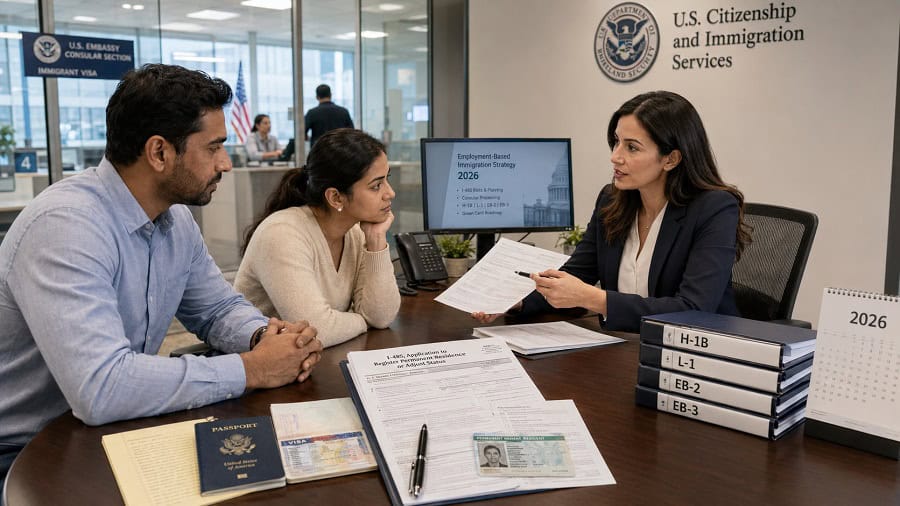
The main risk after PM-602-0199 is not that Form I-485 has disappeared, but that a case can fail because the record is incomplete, weak, or strategically underdeveloped. A professional who has worked lawfully in the United States for years on H-1B or L-1 status, has an approved Form I-140, a current priority date, and a stable sponsoring employer is generally in a different position from someone who recently entered on B-1/B-2 status, has status gaps, or presents an employment history that raises questions. The correct strategy is not to panic or rely on rumors. It is to assess the facts, strengthen the evidence, and decide whether Form I-485 or consular processing is the stronger route.
- Form I-485 is not banned in employment-based cases, but USCIS now frames adjustment of status as a more exceptional discretionary benefit.
- Statutory eligibility is no longer enough as a planning assumption: the filing should also present positive discretionary factors and a clean factual record.
- H-1B and L-1 cases with clean status history often remain stronger, while cases involving recent visitor entry, status violations, or weak documentation require more caution.
- Consular processing is not automatically safer, but it should be analyzed as a strategic alternative where adjustment risk is elevated.
- Visa Bulletin availability remains a separate gate: even a strong case cannot proceed without a current visa number under USCIS filing instructions.
Applicants, employers, and family members should review the adjustment route carefully before filing or continuing a pending Form I-485, especially when the case involves status gaps, job changes, recent entry, EAD/AP use, portability, or a possible consular-processing alternative.
What PM-602-0199 actually changes for employment-based Form I-485 cases
USCIS has long treated adjustment of status under INA §245 as a discretionary benefit, but PM-602-0199 and the accompanying public statements make that principle much more operational. In practical terms, an officer may now place greater weight not only on whether the applicant can technically file Form I-485, but also on whether the overall case merits a favorable exercise of discretion. In employment-based matters, this is significant because the green card process often spans several years and involves PERM labor certification where required, Form I-140 adjudication, waiting for the priority date to become current, and then choosing between adjustment of status in the United States or immigrant visa processing abroad.
For years, many applicants and even some employers treated Form I-485 as a largely administrative last step once Form I-140 was approved and the Visa Bulletin allowed filing. PM-602-0199 disrupts that assumption. A strong final-stage filing now needs a coherent record showing lawful entry, maintenance of status where required, authorized employment, the absence of serious violations, and a continuing factual basis for the employment-based petition.
The memo does not rewrite the substantive standards for EB-1, EB-2, EB-2 NIW, EB-3, PERM, or Form I-140. Those category rules remain the same. What changes is the level of scrutiny at the adjustment stage. Applicants should now expect USCIS to look more closely at whether adjustment in the United States is justified on both legal and discretionary grounds.
- Statutory eligibility to file Form I-485: lawful admission or parole, an available immigrant visa number, no controlling statutory bar, and eligibility under the selected EB category.
- Discretionary review by USCIS: status history, employment authorization, travel history, possible violations, employer continuity where relevant, admissibility concerns, and positive factors that support approval.
- Route strategy: adjustment of status inside the United States versus consular processing through NVC and DS-260. After the memo, this choice is more strategic and less automatic.
Why this is not a ban on Form I-485, but also not a routine technical update
The most common mistake after PM-602-0199 is to read it in extremes. One extreme is to assume that Form I-485 is effectively gone for employment-based cases. That is inaccurate. Adjustment of status remains a lawful statutory mechanism. The other extreme is to say that nothing meaningful changed because adjustment has always been discretionary. That is also incomplete. USCIS has chosen to foreground discretion, to characterize adjustment as an extraordinary form of relief, and to signal that officers should not treat it as a routine substitute for immigrant visa processing.
This means the correct response is not panic, but case triage. Before filing or continuing a case, it is important to identify facts that may be viewed negatively in discretionary review: status violations, unauthorized employment, recent entry in a category that is sensitive to immigrant intent, incomplete tax or lawful-employment records where relevant, inconsistencies in the immigration or biographical record, weak evidence of a current job offer, major role changes after PERM, or an underdeveloped continuing-plan narrative in an EB-2 NIW matter.
The legal requirements under INA §245 remain central. The applicant must be physically present in the United States, have been inspected and admitted or paroled, be eligible for an immigrant visa, have an immigrant visa number available, and not be blocked by a controlling bar. But after PM-602-0199, those points should be presented as the legal floor, not the entire strategy. A well-prepared case should show both eligibility and why the facts support a favorable discretionary decision.
- It does not repeal Form I-485: adjustment of status continues to exist under U.S. immigration law.
- It does not eliminate EB-1, EB-2, EB-2 NIW, or EB-3: category requirements, Form I-140 standards, and PERM where applicable remain in place.
- It does not automatically deny pending I-485 cases: those cases must still be decided on their facts, visa availability, and the quality of the record.
- It does not mean every applicant should move to consular processing: consular processing is a strategic alternative, not a universal answer.
| Issue | What changed | What did not change |
|---|---|---|
| Form I-485 | USCIS now places heavier emphasis on discretion and on whether adjustment in the United States is justified in the specific case. | Form I-485 remains a lawful mechanism for eligible applicants under INA §245. |
| EB-1 / EB-2 / EB-3 | Applicants should document status history, authorized employment, petition continuity, and positive discretionary factors more carefully. | The core category requirements, Form I-140, PERM where applicable, and the priority date remain central. |
| Visa Bulletin | For June 2026 employment-based Form I-485 filings, USCIS requires applicants to use the Final Action Dates chart, narrowing who may file. | Visa number availability still depends on the Visa Bulletin and monthly USCIS filing-chart instructions. |
| Consular Processing | NVC and DS-260 strategy may become more important where a case carries higher adjustment risk. | Consular processing still carries its own risks, including 221(g), administrative processing, interview delays, and inadmissibility issues. |
Risk map by status: H-1B, L-1, F-1/OPT, B-1/B-2, and EB-2 NIW
After PM-602-0199, risk cannot be assessed only by the EB category. Two EB-2 applicants may present very different profiles. One may have spent years in H-1B status with a clean record and a stable sponsoring employer. Another may have a more fragile history involving recent visitor entry, uncertain work authorization, or inconsistent status maintenance. Both may be technically exploring adjustment of status, but the discretionary analysis is unlikely to look the same.
Dual-intent classifications such as H-1B and L-1 often present a more stable platform for adjustment when status has been maintained, employment was authorized, and the sponsoring job remains available. More sensitive profiles can arise in F-1/OPT, STEM OPT, TN, E-2, and especially B-1/B-2 cases, where USCIS may review timing, intent at entry, and any unauthorized work more carefully.
B-1/B-2 status is not a denial ground by itself. The concern is not the visa label alone, but whether the surrounding facts suggest a pre-existing immigrant plan at entry, a rapid and poorly explained change of plans, or conduct inconsistent with the stated purpose of admission. In other words, recent visitor entry does not automatically defeat an adjustment case, but it often increases the need for a disciplined factual explanation.
Relative Form I-485 vulnerability after PM-602-0199
This chart reflects practical vulnerability, not an official USCIS ranking. Outcomes depend on the full record: lawful entry, admissibility, visa availability, employment continuity where required, and the quality of the evidence.
| Current status | Position after the memo | What strengthens the case | What increases risk |
|---|---|---|---|
| H-1B | usually stronger | Dual intent, stable payroll history, a continuing job offer, and no gaps in status. | Job loss, a weak employer record, portability problems, or a role that no longer matches the sponsored position. |
| L-1 | usually stronger | A documented qualifying relationship, a real managerial or specialized knowledge role, and continuity of employment. | Questions about the qualifying company relationship, business restructuring, or a role that does not fit the petition record. |
| F-1/OPT | moderate to elevated risk | Clean SEVIS history, authorized employment, and a logical academic-to-professional trajectory. | SEVIS gaps, work outside authorization, or abrupt immigration changes without supporting documentation. |
| B-1/B-2 | elevated risk | Well-documented changed circumstances, a clean immigration history, and a credible explanation supported by evidence. | Facts suggesting pre-existing immigrant intent at entry, recent filing after admission, or conduct inconsistent with visitor status. |
What to review if your Form I-485 is already pending
If Form I-485 has already been filed and remains pending, abrupt decisions are usually unhelpful. A pending I-485 is not the same thing as holding H-1B, L-1, or another nonimmigrant status, but it does create a procedural basis for remaining in the adjudication process. After PM-602-0199, applicants should assume that USCIS may review discretionary factors more closely at final adjudication, especially where the case involves an RFE, an interview, an updated medical exam, a transfer to a field office, or a change in employer or role.
In employer-sponsored matters, the continuing job offer should be reviewed with precision. If the Form I-485 has been pending for 180 days or more and the applicant changed employers or roles, INA 204(j), Supplement J, and the requirement that the new position be in the same or a similar occupational classification become central. In EB-2 NIW or EB-1A cases, where a specific sponsoring employer may not be required, the focus instead shifts to whether the applicant continues to work in the proposed field and whether the endeavor remains real, active, and beneficial.
- Status history: entries, I-94 records, visas, approval notices, extensions, changes of status, periods of authorized stay, and any possible gaps.
- Employment history: employer, job title, duties, salary, worksite, remote or hybrid structure, and consistency with PERM or Form I-140.
- EAD/AP use: use of the Employment Authorization Document and Advance Parole may affect the strategy for preserving the underlying nonimmigrant status.
- Derivative applicants: spouses and children should have consistent travel, status, and document records; CSPA issues should be reviewed early rather than at the last minute.
- Positive factors: lawful employment, clean status history, family stability, professional contributions, and, where relevant, orderly tax records and community ties.
This is often a more stable adjustment scenario when status has been maintained, employment has remained authorized, pay records confirm ongoing work, and the offered permanent position is still available. The main risk usually lies not in the memo itself, but in a mismatch between the actual job and the sponsored position described in PERM and Form I-140.
In this profile, SEVIS compliance, correct employment authorization, the relationship between the job and the academic field, and the absence of unauthorized work are critical. Where there were gaps or employer changes, documentary support is more persuasive than a late verbal explanation.
In NIW cases, the applicant should show that the proposed endeavor remains current and credible. Useful updates may include contracts, publications, grants, patents, project milestones, implementation evidence, client records, or impact data that show the work has not stalled.
New Form I-485 filings: evidence that matters more after the memo
For new filings after PM-602-0199, it is risky to treat Form I-485 as a basic packet of forms and identity documents. A strong filing should tell a clear story: how the applicant entered the United States, what status was held over time, where and how the applicant worked, why the work was authorized, how the immigrant petition basis remains valid, and why adjustment in the United States is a factually supportable route.
Not every case requires a lengthy legal brief, but USCIS should not be left to infer the core facts. If the applicant remains with the PERM employer, a current employment confirmation letter is important. If the role is now remote or hybrid, the worksite arrangement and consistency with the original labor certification should be addressed. If portability is being used, Supplement J and a detailed same-or-similar analysis should be prepared. If the case is based on NIW, fresh evidence should show ongoing work in the proposed endeavor and continued national importance.
| Evidence category | What to show | Why it matters |
|---|---|---|
| Lawful entry and status | I-94, visas, approval notices, SEVIS or status documents, and extension or change-of-status history. | Unclear status periods or unsupported gaps may become negative discretionary factors. |
| Employment continuity | Employer letter, duties, salary, pay records, worksite details, and confirmation of the permanent position where required. | In EB cases, USCIS may test whether the employment-based foundation remains genuine and current. |
| Positive discretionary factors | Lawful employment, a clean immigration record, family stability, professional contribution, and where relevant, orderly tax documentation. | These facts help explain why adjustment inside the United States merits a favorable exercise of discretion. |
| Reasons for filing inside the United States | Work, family, medical, or other circumstances that make adjustment a practical and well-supported route in the specific case. | In sensitive cases, it can help USCIS understand why the applicant is pursuing AOS instead of consular processing. |
For June 2026, USCIS states that all employment-based preference filings must use the Final Action Dates chart from the Visa Bulletin. This planning point matters independently from the memo: even a strong case cannot file Form I-485 unless the priority date is current under the chart USCIS designates for that month.
When NVC and DS-260 consular processing may be a rational backup route
Consular processing is not a failure and not a lesser path. After PM-602-0199, it may become the more rational option in some cases where adjustment risk is elevated. The consular route typically proceeds through the National Visa Center: after petition approval, NVC creates the case, fees are paid, Form DS-260 is submitted, civil documents are collected, and the applicant eventually attends an immigrant visa interview at a U.S. embassy or consulate.
That does not mean consular processing is automatically safer. It has its own risks: 221(g) administrative processing, interview backlogs, police-certificate issues, medical examination concerns, inadmissibility findings, travel logistics, and possible work disruption in the United States. NVC and DS-260 should therefore be viewed as a strategic alternative, not as a universal remedy for adjustment uncertainty.
In employment-based matters, a key question is whether the underlying offer or petition basis can remain stable through the consular process. In employer-sponsored cases, the employer should confirm that the permanent job remains available and consistent with PERM and Form I-140. In self-petitioned or NIW cases, the applicant should be ready to show that the qualifying achievements or proposed endeavor remain active and credible.
- The applicant has sensitive discretionary issues for Form I-485 but no obvious inadmissibility problem for consular processing.
- The applicant’s current U.S. status is unstable, and a domestic filing may trigger additional scrutiny on intent or status history.
- The employer is able to keep the permanent job offer available until visa issuance.
- The family can manage the interview logistics, required civil documents, and possible time abroad without severe disruption.
- The priority date is current or close to current, making parallel NVC planning worthwhile.
Employer checklist: PERM, Form I-140, job offer, and Supplement J
For employers, PM-602-0199 means the final stage of the EB process requires more active control. It is no longer enough to complete PERM, secure Form I-140 approval, and assume that the employee’s Form I-485 will function as a routine closing step. If USCIS reviews the real-world status of the job offer more closely, the employer should preserve a clear documentary line from PERM through final adjudication.
Remote and hybrid roles, multiple worksites, changed duties, promotions, restructuring, entity changes, layoffs, and portability all require attention. If PERM described one position but the employee is effectively performing a materially different role by the time I-485 is adjudicated, the employer should analyze whether the case still fits the same or similar occupational classification standard and whether Supplement J is required.
| Review area | What the employer should do | Risk if ignored |
|---|---|---|
| Job offer | Confirm that the permanent full-time offer remains genuine, available, and aligned with the immigrant petition basis. | USCIS may question whether the employment-based foundation of the adjustment case still exists. |
| PERM consistency | Compare duties, minimum requirements, salary structure, location, and worksite arrangements with the current role. | Material inconsistencies can trigger an RFE, NOID, or denial. |
| Ability to pay | Maintain tax, payroll, and financial records showing the ability to pay the offered wage where relevant to the continuing record. | If layoffs, restructuring, or questions about the viability of the offer arise, USCIS may request additional evidence or reassess the strength of the case foundation. |
| Route planning | Evaluate Form I-485 and NVC/DS-260 strategy in advance, especially for employees with sensitive status histories. | The company may lose time if adjustment becomes problematic and no consular backup plan exists. |
FAQ on Form I-485, EAD/AP, the Visa Bulletin, and consular processing
Can applicants still file Form I-485 in EB-1, EB-2, or EB-3 cases?
Yes, when the applicant meets the legal requirements, has an available immigrant visa number, and is not blocked by a controlling inadmissibility issue or adjustment bar. After PM-602-0199, however, the filing should also be prepared to demonstrate lawful entry, status history, authorized employment, the current petition basis, and positive discretionary factors.
What should I do if my Form I-485 is already pending?
Review the record before reacting. Focus on status history, employment history, EAD/AP use, travel, the continuing job offer or ongoing NIW endeavor, and any possible weak spots that could draw an RFE or interview question. Gather I-94 records, approval notices, pay records, a current employment letter, Supplement J if relevant, and a clean explanation of any role or employer changes.
Does an EAD based on a pending Form I-485 mean the underlying status no longer matters?
Not necessarily. An EAD authorizes employment, but it is not the same thing as continuing to maintain H-1B, L-1, or another nonimmigrant status. In a stricter discretionary environment, preserving the underlying status where possible may remain strategically valuable, especially if the adjustment case is delayed or challenged.
How does the Visa Bulletin affect strategy after the memo?
The Visa Bulletin remains a gatekeeper. Each month, USCIS decides whether employment-based applicants may use Final Action Dates or Dates for Filing. In June 2026, employment-based filings must use Final Action Dates, so a case cannot rely on the more favorable Dates for Filing chart if USCIS has not authorized it.
Should all EB applicants switch to consular processing?
No. For many H-1B and L-1 applicants with clean histories, strong employer support, and a current priority date, Form I-485 may still remain the better route. But applicants with recent visitor entry, intent concerns, status problems, or weak records should evaluate NVC and DS-260 more seriously than before.
Should I withdraw my Form I-485 and move to NVC?
Not automatically. Withdrawing a pending I-485 may affect work authorization, travel, dependent family members, and overall status strategy. That decision should be based on a full review of the case history, current status, visa timing, employer support, inadmissibility risks, and the practical consequences of shifting abroad for consular processing.
What matters most for EB-2 NIW after PM-602-0199?
In EB-2 NIW cases, USCIS is likely to focus on whether the proposed endeavor remains real, current, and beneficial. Strong evidence may include updated projects, publications, grants, contracts, support letters, patents, clients, funding, implementation records, or measurable indicators of national importance and impact.
Official sources for verification
This article is based on official USCIS and U.S. Department of State resources. Because USCIS filing-chart instructions and the Visa Bulletin are updated regularly, Form I-485 filing eligibility should always be checked against the current month rather than against old screenshots or saved summaries.
- USCIS Policy Memoranda
- USCIS PM-602-0199: Adjustment of Status and Discretion
- USCIS news release on Adjustment of Status and extraordinary circumstances
- USCIS Adjustment of Status Filing Charts from the Visa Bulletin
- U.S. Department of State Visa Bulletin
- National Visa Center Processing
- DS-260 Immigrant Visa Electronic Application
Guidance on related U.S. immigration categories
Compare eligibility criteria, filing procedures, documentation requirements, and practical considerations for U.S. immigration categories relevant to this topic.
-
Employment-based immigration to the USA
Compare EB-1, EB-2, EB-3, NIW, PERM, I-140 and final green card planning in one employment-based framework.
-
EB-1 talent visa
Review the first-preference employment-based category and its three subcategories.
